Does Ultrasound Use Radiation?
A direct patient answer: standard diagnostic ultrasound uses sound energy, not X-ray radiation — plus plain-language comparisons to CT, X-ray, and MRI.
Standard diagnostic ultrasound does not use ionizing radiation — the type of energy in X-rays and CT scans. It creates images with high-frequency sound waves. Ultrasound still transfers acoustic energy into tissue, which is managed separately from X-ray dose; see is ultrasound safe for overall safety context.
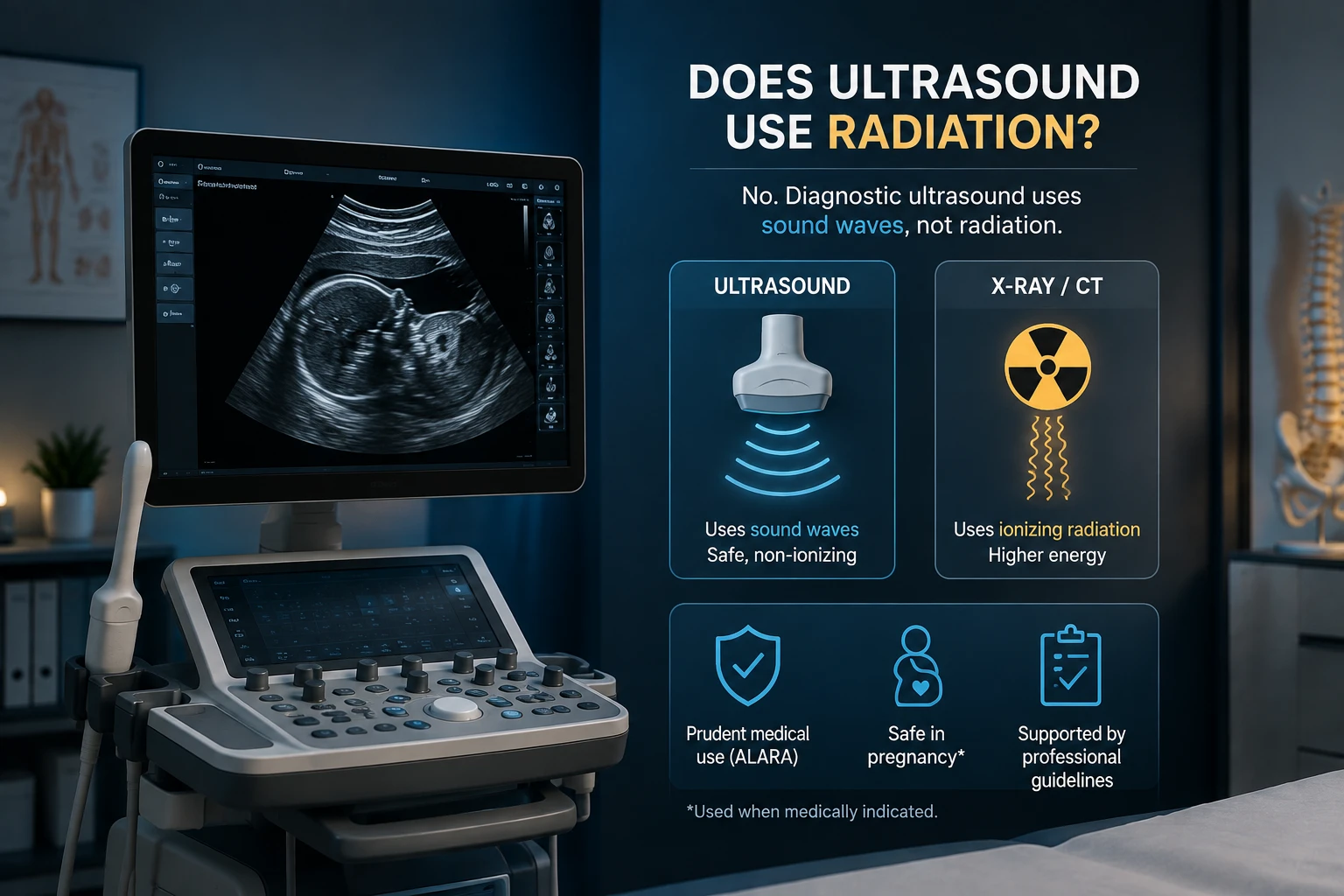
This article explains radiation exposure from diagnostic medical ultrasound only — not therapeutic ultrasound or contrast-enhanced studies. Patients often ask whether an ultrasound “uses radiation” because they associate medical scans with X-rays. Standard diagnostic ultrasound does not use ionizing radiation (the type used in X-rays and CT). Instead, it uses controlled sound waves to build images. Below is how that difference works in everyday terms and how ultrasound compares to other common tests.
Does Ultrasound Use Radiation?
No — diagnostic ultrasound does not use ionizing radiation. The FDA describes ultrasound imaging as using sound waves to view the inside of the body, unlike X-ray imaging which uses ionizing radiation. Patient resources from RadiologyInfo (a joint patient site of the American College of Radiology and Radiological Society of North America) likewise state that ultrasound (sonography) does not use ionizing radiation.
Colloquially, people sometimes say “radiation” for any energy passing into the body. In medical safety language, ionizing radiation means X-rays, gamma rays, and similar energies that can remove electrons from atoms and are managed with dose concepts used in radiography and CT. Ultrasound transfers mechanical (acoustic) energy at diagnostic frequencies — a different category entirely.
If you need the broader safety picture — pregnancy epidemiology, ALARA for acoustic output, or repeated exams — see is ultrasound safe. This page stays focused on the radiation question.
Ionizing vs Non-Ionizing (Plain Language)
Ionizing radiation carries enough energy to ionize atoms. Medical imaging that relies on ionizing radiation includes conventional X-rays and CT scans. Non-ionizing forms of energy do not ionize atoms in the same way; diagnostic ultrasound is classified among non-ionizing medical technologies, along with MRI (which uses magnetic fields and radio waves, not X-rays).
Protection literature groups diagnostic ultrasound with non-ionizing devices that operate through mechanical oscillation in roughly the megahertz range used clinically. That classification helps physicists and regulators set limits — but for patients the practical takeaway is simpler: ultrasound is not an X-ray test.
National Council on Radiation Protection reports that discuss prenatal imaging distinguish ionizing sources from nonionizing sources such as ultrasound. Those documents support education but are not a substitute for your clinician’s choice of test.
How Ultrasound Differs From X-Ray and CT
X-ray radiography and CT pass ionizing X-rays through the body to form images. Ultrasound sends short pulses of sound and analyzes echoes. Reviews of bedside and emergency imaging note that choosing ultrasound for questions it can answer — such as some abdominal or vascular evaluations — avoids the ionizing exposure that would accompany chest radiography or CT for the same workup when those alternatives are used.
Clinical trials in selected settings illustrate the pattern: pathways that use ultrasound first for certain suspected conditions can reduce cumulative ionizing radiation compared with CT-first strategies, when ultrasound is diagnostically adequate. That is an example, not a rule that ultrasound replaces CT for every condition.
When your team orders CT instead of ultrasound, it is usually because cross-sectional X-ray detail is needed for your specific question. See understanding CT scans for what CT is and why it is used — without repeating CT prep or dose tables here.
Ultrasound, MRI, and Other Scans
Both standard diagnostic ultrasound and MRI avoid ionizing radiation. They are not interchangeable: MRI excels for many soft-tissue and brain questions but requires different safety screening (for example metal implants), while ultrasound is often performed at bedside with real-time motion. A single paragraph cannot rank them; your clinician matches the test to the question.
Mammography and fluoroscopy use ionizing X-rays. If you are comparing “which of my tests used radiation,” ask your facility for a list or discuss with your ordering clinician.
Does This Mean Ultrasound Has Zero Energy or Risk?
Ultrasound still delivers acoustic energy into tissue, which can warm tissue or, at very high outputs, produce mechanical effects. That is why regulators and societies emphasize prudent scanning time and output — separate from ionizing dose. Lay articles should say “no ionizing radiation” rather than “no energy at all.”
Thermal and mechanical indices on machines help operators monitor exposure. Patient-facing safety depth — including pregnancy and ALARA — lives in is ultrasound safe rather than in this radiation-focused article.
Ultrasound in Pregnancy and Children (Radiation Angle Only)
From an ionizing-radiation standpoint, diagnostic ultrasound does not expose the fetus or child to X-ray dose. Concerns about fetal X-ray or CT exposure are managed with different principles (shielding, justification, dose optimization). Obstetric safety, nonmedical scanning policy, and epidemiology belong on is ultrasound safe and is 3D ultrasound safe rather than here.
Three-dimensional display modes still use diagnostic ultrasound energy, not ionizing radiation — session length and medical indication remain important for overall safety.
Key Takeaways
- No — diagnostic ultrasound does not use ionizing radiation.
- Ionizing radiation carries enough energy to ionize atoms.
- X-ray radiography and CT pass ionizing X-rays through the body to form images.
- Both standard diagnostic ultrasound and MRI avoid ionizing radiation.
- Ultrasound still delivers acoustic energy into tissue, which can warm tissue or, at very high outputs, produce mechanical effects.
Frequently Asked Questions
Does ultrasound use ionizing radiation?
No. Standard diagnostic ultrasound uses sound (acoustic) energy, not ionizing X-rays.
Is ultrasound the same as an X-ray for radiation?
No. X-rays and CT use ionizing radiation; ultrasound does not.
Is a sonogram radiation-free?
Sonogram and ultrasound mean the same test — no ionizing radiation. The scan still uses controlled sound energy.
Does 3D ultrasound use radiation?
3D ultrasound displays volume data from the same non-ionizing sound-based exam; it is not an X-ray test.
Is ultrasound safer than a CT scan for radiation?
Ultrasound avoids ionizing exposure; CT uses X-rays. Which exam you need depends on the clinical question, not radiation alone.
Does ultrasound use the same radiation as a mammogram?
No. Mammography uses ionizing X-rays; diagnostic ultrasound does not.
Related articles
Glossary · Frequently asked questions · All Learning Center articles