From Images to Mesh: How 3D Mesh Generation Works
How a segmented anatomical structure becomes a clean, printable 3D mesh ready for manufacturing.
Mesh generation converts a segmented anatomical structure into a triangulated digital surface, typically an STL file, using algorithms like marching cubes to trace the boundary between inside and outside the structure. The raw mesh is then cleaned, smoothed, and checked for watertight, printable geometry before it moves on to production.
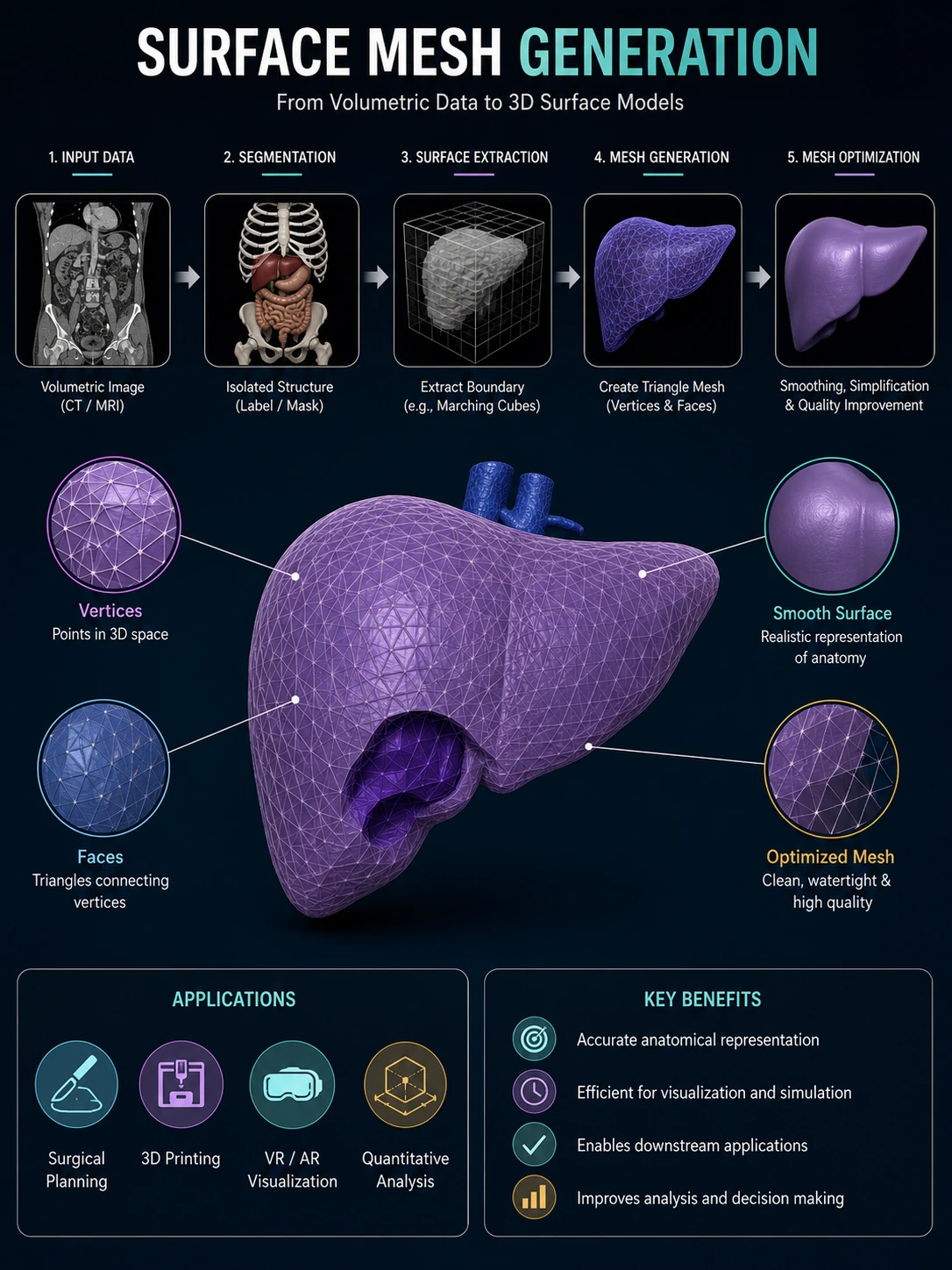
Once anatomy has been segmented, it still isn't ready to print. Mesh generation is the technical bridge between a segmented digital structure and a manufacturable 3D object.
What Is a Mesh?
A mesh is a digital surface made up of many small, connected triangles (or polygons) that together approximate the shape of a 3D object — the same basic format used across 3D printing, gaming, and animation.
The most common medical 3D printing mesh format is STL, though newer formats support additional data like color and material.
Surface Extraction from Segmented Volumes
Algorithms such as marching cubes scan through the segmented voxel data and generate a triangulated surface at the boundary between 'inside' and 'outside' the structure of interest.
The result is an initial, often rough, mesh that faithfully — but not yet smoothly — represents the segmented anatomy.
Cleaning, Smoothing, and Repairing the Mesh
Raw extracted meshes commonly contain small holes, disconnected 'floating' fragments, or jagged surfaces from the underlying voxel grid — all of which are cleaned up in this stage.
Smoothing algorithms reduce this 'stair-step' appearance while carefully preserving genuine anatomical detail, a balance that requires both software and trained judgment.
Preparing the Mesh for Printing
The finalized mesh is checked for manifold geometry (a watertight, printable surface with no gaps), appropriately scaled, and oriented to minimize the need for support structures during printing.
Wall thickness is also verified to ensure delicate anatomical features will survive both the printing process and normal handling afterward.
Key Takeaways
- A mesh is a digital surface made up of many small, connected triangles (or polygons) that together approximate the shape of a 3D object — the same basic format used across 3D printing, gaming, and animation.
- Algorithms such as marching cubes scan through the segmented voxel data and generate a triangulated surface at the boundary between 'inside' and 'outside' the structure of interest.
- Raw extracted meshes commonly contain small holes, disconnected 'floating' fragments, or jagged surfaces from the underlying voxel grid — all of which are cleaned up in this stage.
- The finalized mesh is checked for manifold geometry (a watertight, printable surface with no gaps), appropriately scaled, and oriented to minimize the need for support structures during printing.
Frequently Asked Questions
What is an STL file?
STL is a common 3D mesh file format that describes an object's surface as a collection of connected triangles, widely used across 3D printing.
Does mesh smoothing lose anatomical accuracy?
Well-controlled smoothing removes voxel-grid artifacts while preserving genuine anatomical shape; excessive smoothing can blur fine detail, which is why review is important.
Related articles
Glossary · Frequently asked questions · All Learning Center articles