How Ultrasound Image Quality Affects 3D Printing
Not every ultrasound file can become a highly detailed print. Here are the technical quality factors that actually determine the outcome.
Not every ultrasound file prints equally well: true volumetric (3D/4D) data, resolution, noise, motion blur, and the specific probe used all affect how much surface detail survives conversion into a printable mesh. A single flat 2D photo, however sharp, cannot be 3D printed because it never contained depth information to begin with.
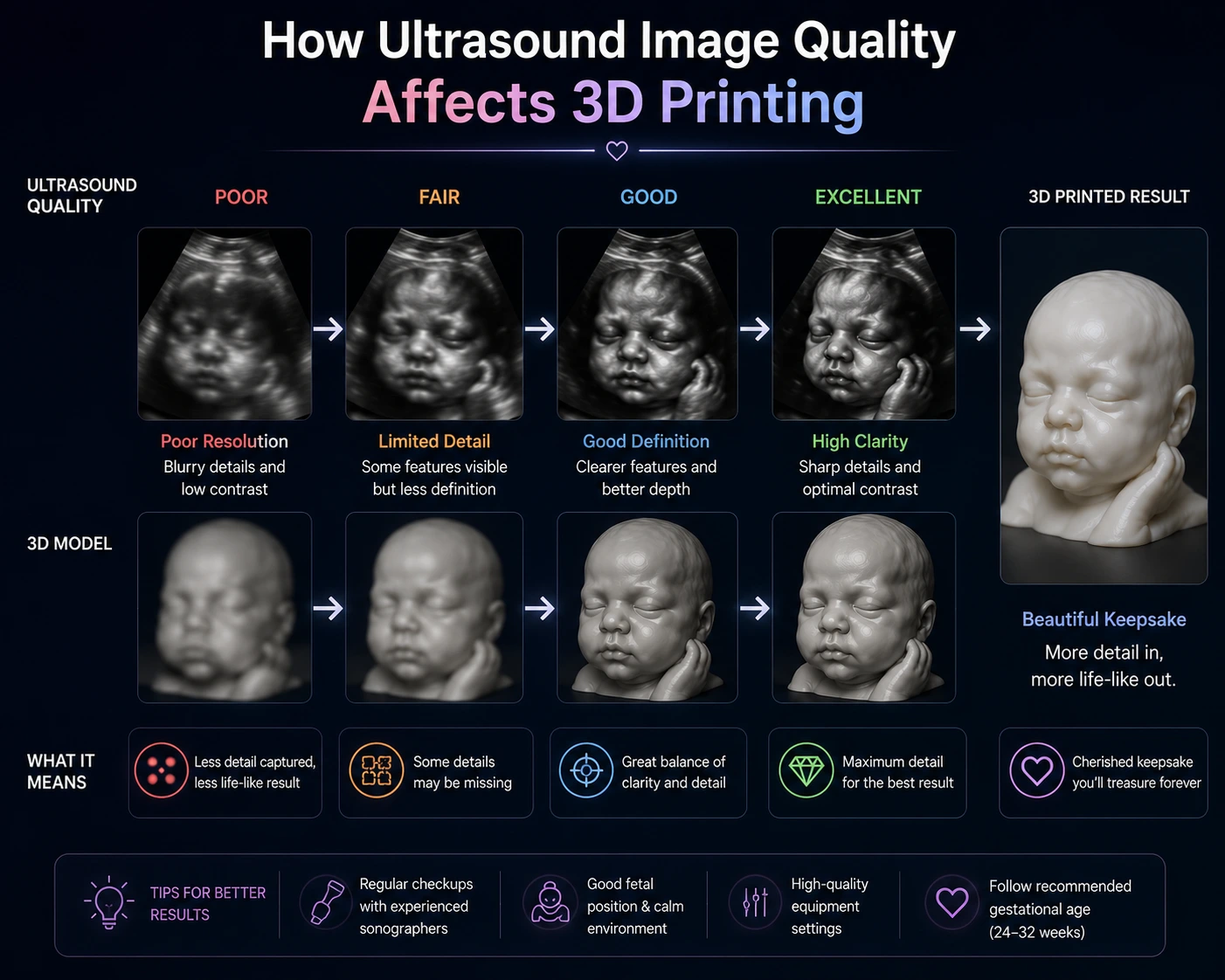
Families sometimes assume any ultrasound file can produce a highly detailed keepsake. In reality, several measurable technical factors determine how much surface detail is actually recoverable, independent of the printer or finishing process.
Volume Data vs. Static Images
A true 3D or 4D volume contains depth information across many slices, which is what allows a printable surface to be reconstructed. A single flat 2D still photo — even a high-resolution one — does not contain that depth data.
This is the most common misunderstanding we encounter: a beautiful printed photo cannot be converted into an accurate physical model because the underlying geometry was never captured.
Resolution, Noise, and Motion
Higher-resolution volumes capture finer surface detail, while lower-resolution or heavily compressed exports can appear blocky or soft once converted to a mesh.
Noise (speckle, common to all ultrasound) and motion blur from fetal movement during acquisition both reduce the sharpness of the final surface.
Machine and Probe Differences
Different ultrasound systems and transducer types produce meaningfully different volume quality. Newer matrix-array probes generally capture cleaner, denser volumetric data than older mechanical 3D probes.
This is one reason two scans at the same gestational week, from different clinics or machines, can produce noticeably different keepsake results.
How We Assess Print Feasibility
Our team visually and technically inspects each submitted volume for fluid coverage, surface continuity, noise level, and structural completeness before confirming an order.
If a file has significant limitations, we'll tell you plainly what to expect rather than printing a result that doesn't meet a reasonable quality bar.
Key Takeaways
- A true 3D or 4D volume contains depth information across many slices, which is what allows a printable surface to be reconstructed.
- Higher-resolution volumes capture finer surface detail, while lower-resolution or heavily compressed exports can appear blocky or soft once converted to a mesh.
- Different ultrasound systems and transducer types produce meaningfully different volume quality.
- Our team visually and technically inspects each submitted volume for fluid coverage, surface continuity, noise level, and structural completeness before confirming an order.
Frequently Asked Questions
Does a higher-resolution ultrasound always mean a better keepsake?
Generally yes, but positioning and fluid coverage often matter more than raw resolution alone.
Can you improve a low-quality ultrasound file?
We can perform reasonable mesh cleanup and smoothing, but we cannot fabricate detail that was never captured in the source volume.
Related articles
Glossary · Frequently asked questions · All Learning Center articles