The Future of Patient-Specific Medicine
How 3D printing and personalized data are shaping the next decade of individualized healthcare.
Patient-specific medicine tailors care and tools to an individual's own anatomy rather than population averages, and 3D printing is one tangible expression of that shift. As segmentation software, AI assistance, and printer accessibility keep improving, patient-specific models are becoming faster and less expensive to produce across both clinical and consumer applications.
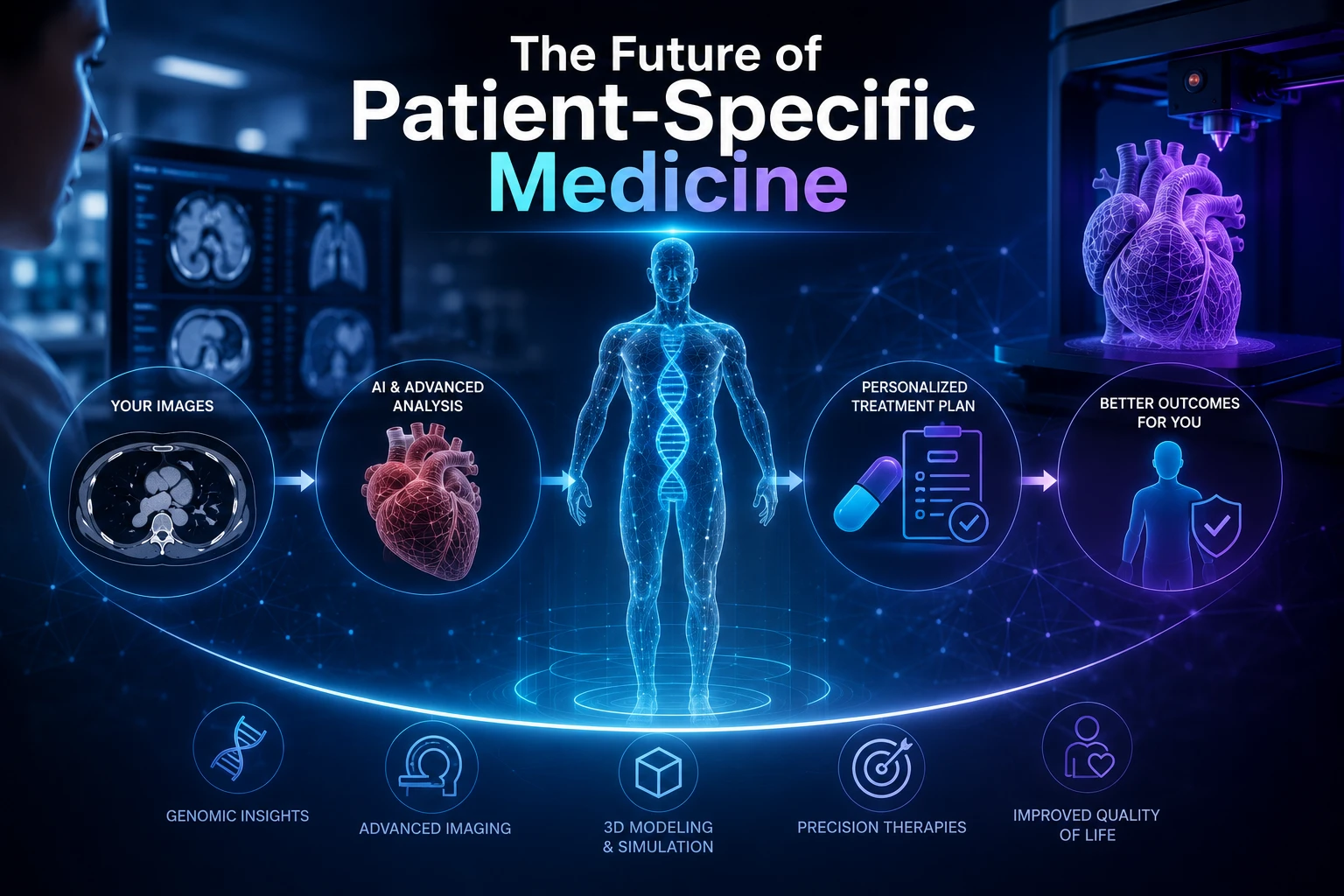
Patient-specific medicine — care and tools tailored to an individual's own anatomy and biology rather than population averages — is one of the defining trends in modern healthcare. 3D printing is a visible, tangible part of that shift.
What Patient-Specific Medicine Means
The broader movement toward personalized medicine spans genomics, targeted therapeutics, and individualized treatment planning — of which patient-specific anatomical modeling is one concrete, physical expression.
Rather than relying solely on generalized anatomical references, clinicians increasingly have access to tools built from the specific patient in front of them.
3D Printing's Growing Role
As segmentation software, AI-assisted tools, and printer accessibility continue to improve, the cost and time required to produce a patient-specific model continue to decrease.
This trend has expanded 3D printing's reach from major academic medical centers to smaller clinics, and to consumer-facing applications like fetal keepsakes.
Emerging Trends to Watch
Multi-material printing (combining rigid and flexible materials to better mimic real tissue behavior), faster AI-assisted segmentation, and improved imaging resolution are all active areas of development.
Researchers are also exploring bioprinting — a related but distinct field focused on printing with living cells — though this remains largely experimental and separate from the anatomical modeling discussed here.
What This Means for Families and Clinicians Today
Practically, this trend means better accessibility, lower cost, and faster turnaround for both clinical anatomical models and commemorative keepsakes than was possible even a few years ago.
It also means the field will keep evolving — today's workflow represents current best practice, not a final, unchanging standard.
Key Takeaways
- The broader movement toward personalized medicine spans genomics, targeted therapeutics, and individualized treatment planning — of which patient-specific anatomical modeling is one concrete, physical expression.
- As segmentation software, AI-assisted tools, and printer accessibility continue to improve, the cost and time required to produce a patient-specific model continue to decrease.
- Multi-material printing (combining rigid and flexible materials to better mimic real tissue behavior), faster AI-assisted segmentation, and improved imaging resolution are all active areas of development.
- Practically, this trend means better accessibility, lower cost, and faster turnaround for both clinical anatomical models and commemorative keepsakes than was possible even a few years ago.
Frequently Asked Questions
Is bioprinting the same as what LifePrint 3D does?
No. Bioprinting involves living cells and is an experimental research field. LifePrint 3D produces solid, non-living physical models from imaging data.
Will 3D printed models become standard in all hospitals?
Adoption continues to grow, particularly for complex surgical cases and education, though usage still varies significantly by institution and specialty.
Related articles
Glossary · Frequently asked questions · All Learning Center articles