The Role of AI in Medical Imaging
Where artificial intelligence is already used in medical imaging today, and where human review remains essential.
AI tools already assist radiologists by flagging findings for review, automating measurements, and proposing initial segmentation boundaries for structures like bone far faster than manual tracing. Because an AI-proposed boundary can look plausible while still being subtly wrong, human review against the original imaging remains a standard part of any responsible workflow.
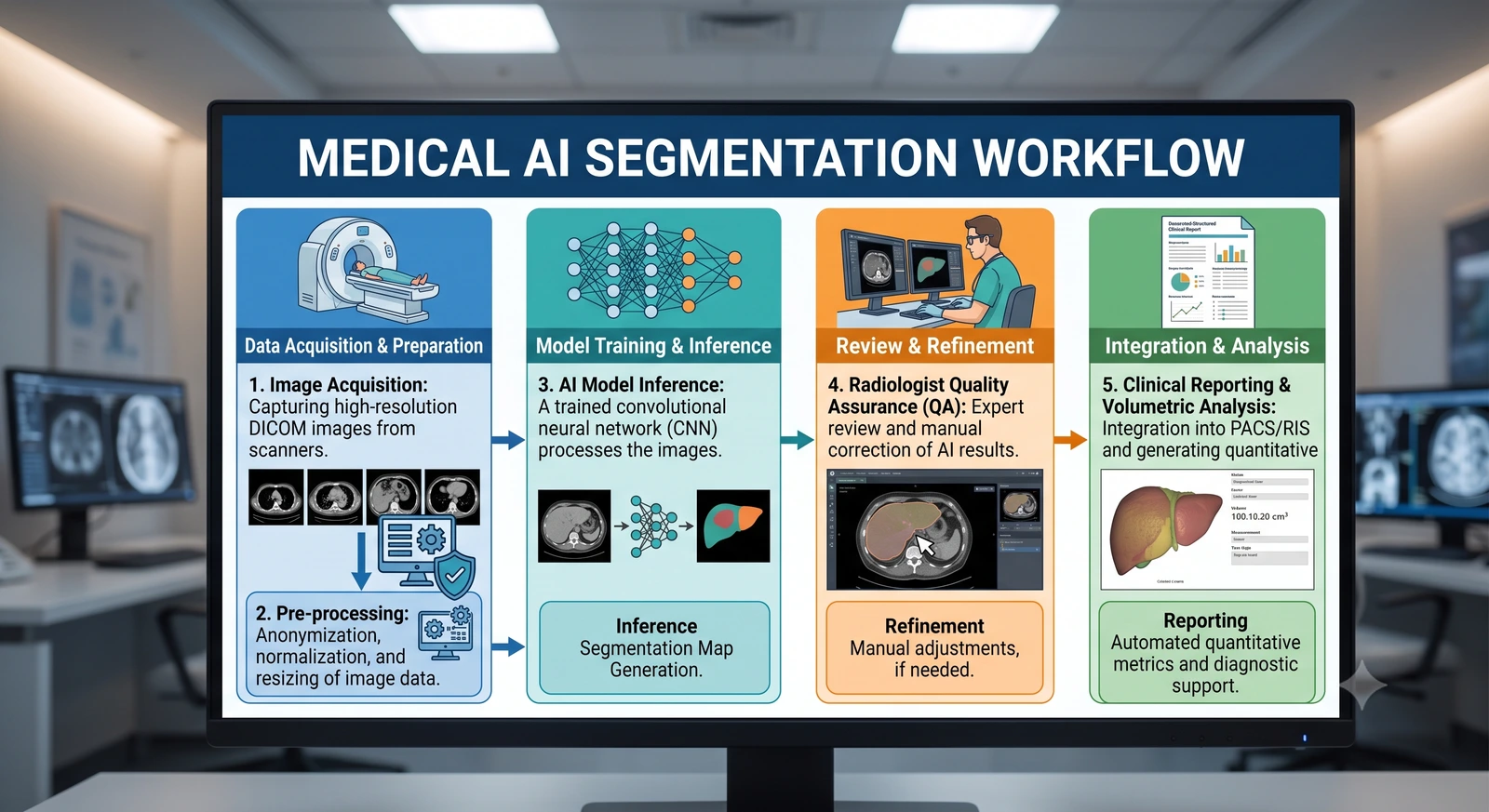
Artificial intelligence has moved quickly from research papers into practical tools across radiology and medical 3D printing. Here's a grounded look at what AI actually does in this space today.
Where AI Is Already Used Today
AI-based tools assist radiologists with tasks like flagging potential findings for review, automating routine measurements, and accelerating image reconstruction — generally as decision support, not replacement, for clinical judgment.
Regulatory-cleared AI tools now exist for specific applications such as detecting certain fracture patterns or highlighting areas warranting closer radiologist attention.
AI-Assisted Segmentation for 3D Printing
In the 3D printing pipeline specifically, AI models can propose initial segmentation boundaries for structures like bone or organs far faster than fully manual tracing, meaningfully reducing production time.
This is particularly useful for well-defined, high-contrast structures where the AI's proposed boundary closely matches what a human reviewer would draw.
Benefits and Current Limitations
The main benefit is speed and consistency on routine cases, freeing human reviewers to focus attention on ambiguous or unusual anatomy that genuinely needs judgment.
Current limitations include reduced reliability on atypical anatomy, noisy or low-quality source data, and structures with subtle or ambiguous boundaries — situations where AI can propose an incorrect boundary with high apparent confidence.
Human Review Still Matters
Because an AI-proposed segmentation can look plausible while still being subtly wrong, human review against the original imaging remains a standard part of any responsible workflow.
At LifePrint 3D, AI-assisted tools may accelerate parts of our process, but every model still passes through physician-informed review before production.
Key Takeaways
- AI-based tools assist radiologists with tasks like flagging potential findings for review, automating routine measurements, and accelerating image reconstruction — generally as decision support, not replacement, for clinical judgment.
- In the 3D printing pipeline specifically, AI models can propose initial segmentation boundaries for structures like bone or organs far faster than fully manual tracing, meaningfully reducing production time.
- The main benefit is speed and consistency on routine cases, freeing human reviewers to focus attention on ambiguous or unusual anatomy that genuinely needs judgment.
- Because an AI-proposed segmentation can look plausible while still being subtly wrong, human review against the original imaging remains a standard part of any responsible workflow.
Frequently Asked Questions
Does LifePrint 3D use AI to create models?
AI-assisted tools may support parts of our segmentation workflow, but every case is reviewed by our team before production — AI does not replace human oversight.
Can AI replace radiologists?
Current AI tools are generally used as decision support for radiologists, not as a replacement for clinical interpretation and judgment.
Related articles
Related images
Glossary · Frequently asked questions · All Learning Center articles