Introduction to Medical 3D Printing
What medical 3D printing means, how the field developed, and where it's used across healthcare today.
Medical 3D printing converts imaging data — typically CT, MRI, or ultrasound — into a physical, three-dimensional object using additive manufacturing. Uses range from patient-specific surgical planning models developed since the 1990s to modern commemorative keepsakes created from a prenatal ultrasound, all built on the same underlying imaging-to-print pipeline.
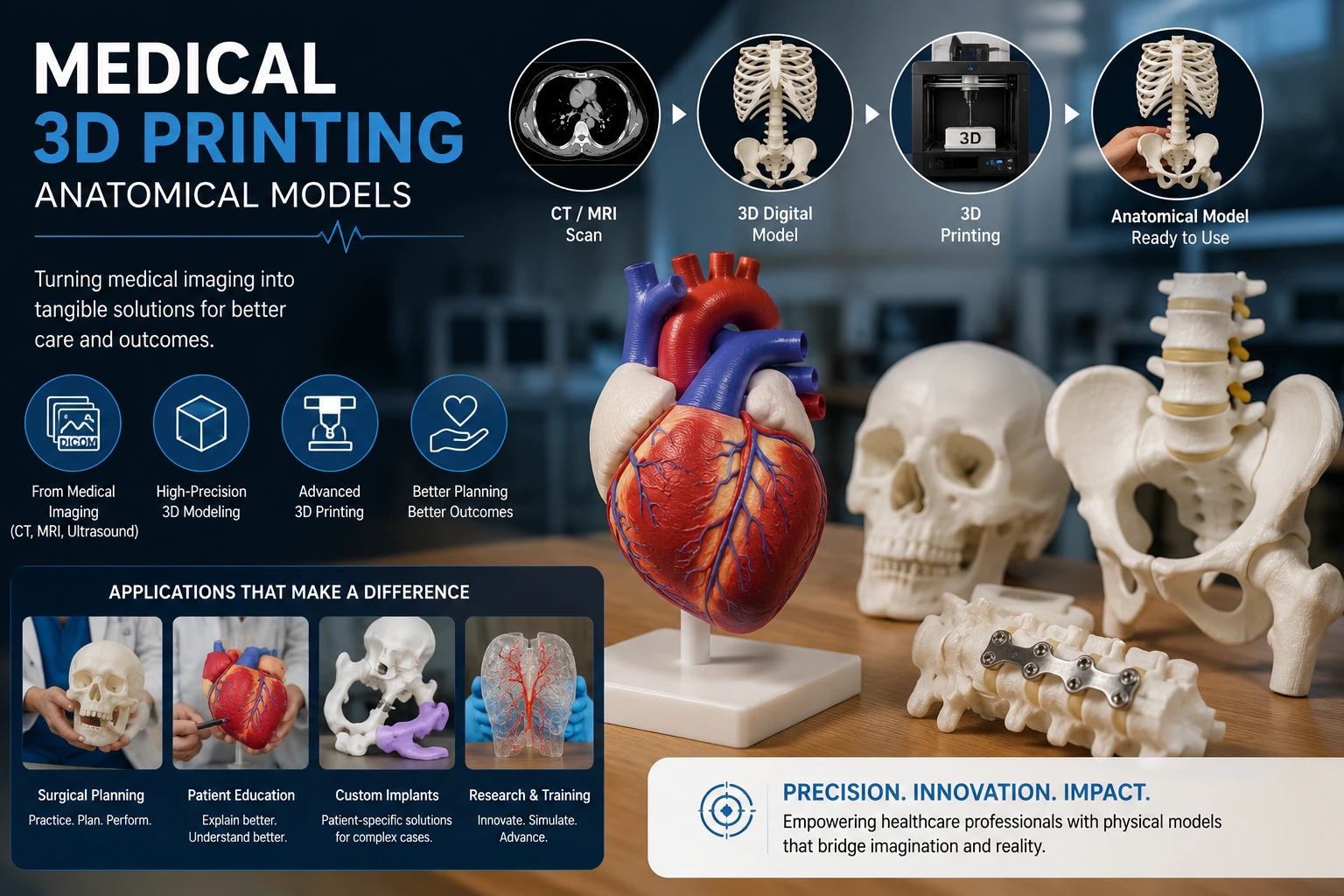
Medical 3D printing has moved from research novelty to an established part of hospital workflows, education programs, and communication tools over the past two decades. Here's a grounded overview of what it is and how it's used.
What Medical 3D Printing Means
At its core, medical 3D printing is the process of converting medical imaging data — typically CT, MRI, or ultrasound — into a physical, three-dimensional object using additive manufacturing.
The resulting object can range from a patient-specific anatomical replica used for surgical planning to a commemorative keepsake created from a prenatal ultrasound.
A Brief History
Early medical 3D printing applications emerged in the 1990s and 2000s, primarily in maxillofacial and orthopedic surgical planning, as segmentation software and printer resolution matured.
Over the following two decades, falling equipment costs and improved software accessibility expanded 3D printing into broader clinical education, patient communication, and eventually consumer-facing keepsake applications.
Common Applications Today
Hospitals and medical schools use printed models for surgical rehearsal, resident training, and explaining complex conditions to patients and families in tangible terms.
Outside the hospital, companies like LifePrint 3D apply the same underlying imaging-to-print pipeline to create keepsakes and educational models directly for individuals and clinics.
Where LifePrint 3D Fits In
We specialize in converting existing imaging — ultrasound for fetal keepsakes, and CT or MRI for anatomical education and communication models — into finished physical objects.
Every model passes through physician review of the segmentation before production, and we clearly label our commemorative products as non-diagnostic.
Key Takeaways
- At its core, medical 3D printing is the process of converting medical imaging data — typically CT, MRI, or ultrasound — into a physical, three-dimensional object using additive manufacturing.
- Early medical 3D printing applications emerged in the 1990s and 2000s, primarily in maxillofacial and orthopedic surgical planning, as segmentation software and printer resolution matured.
- Hospitals and medical schools use printed models for surgical rehearsal, resident training, and explaining complex conditions to patients and families in tangible terms.
- We specialize in converting existing imaging — ultrasound for fetal keepsakes, and CT or MRI for anatomical education and communication models — into finished physical objects.
Frequently Asked Questions
Is medical 3D printing FDA-regulated?
Certain surgical-guide and implant applications fall under medical device regulation. Commemorative and educational models, like those LifePrint 3D produces, are non-diagnostic and are not medical devices.
What imaging types can be 3D printed?
CT, MRI, and volumetric (3D/4D) ultrasound data are all commonly used, provided the exported file contains true depth information.
Related articles
Related images
Glossary · Frequently asked questions · All Learning Center articles