Applications of 3D Printing in Surgical Planning
Why surgeons use physical models, which cases benefit most, and how this supports informed consent.
Surgeons use patient-specific 3D printed models to rehearse complex approaches, measure and rotate anatomy by hand before surgery, and explain a planned procedure more concretely to patients during informed consent. Published research across neurosurgery, cardiac surgery, and orthopedics generally reports improved surgeon confidence and communication for complex or unusual anatomy.
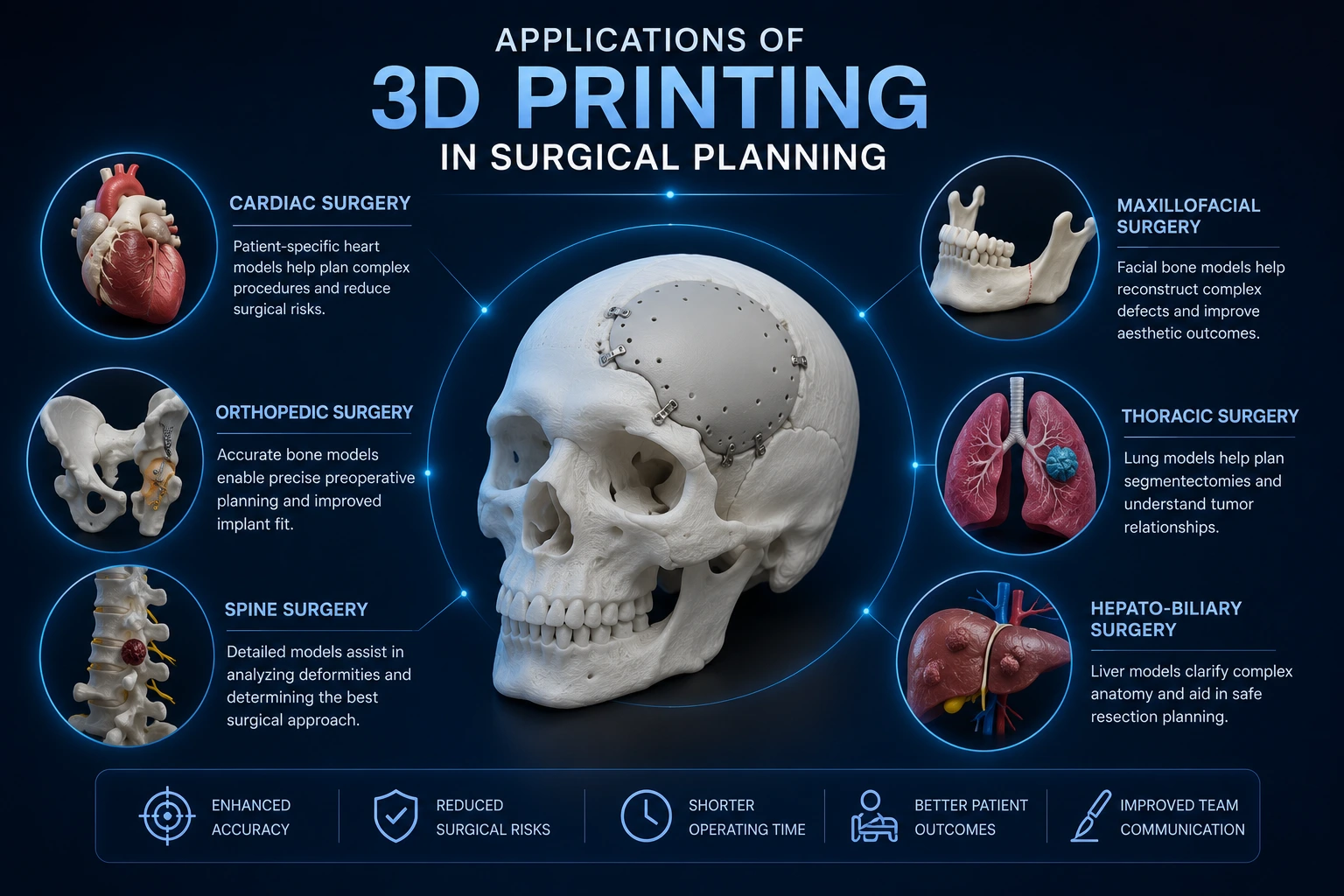
Surgical planning is one of the most established and well-studied applications of medical 3D printing. Here's why physical models continue to earn a place in the operating room workflow.
Why Surgeons Use Physical Models
Even with high-quality 2D and 3D digital imaging on a screen, a physical model provides spatial and tactile information — depth, proportion, and orientation — that can be harder to fully internalize from a monitor alone.
Surgeons can rotate, measure, and rehearse an approach on a physical replica before entering the operating room, which some published studies associate with reduced operative time in complex cases.
Cases Where Models Add the Most Value
Complex craniofacial reconstructions, congenital heart defects, and intricate vascular malformations are frequently cited examples where spatial complexity benefits most from a physical reference.
Cases with unusual or highly individualized anatomy — where a generic teaching model would not reflect the patient's actual structure — also benefit disproportionately from patient-specific printing.
How Models Support Informed Consent
A physical model can help patients and families understand a proposed procedure more concretely than a verbal explanation or a 2D scan image alone, supporting a more informed consent conversation.
This communication benefit is increasingly cited alongside surgical rehearsal as a core value of patient-specific 3D printing.
The Growing Evidence Base
A growing number of peer-reviewed studies have examined 3D printed models across specialties including neurosurgery, cardiac surgery, and orthopedics, generally reporting improved surgeon confidence and communication outcomes.
As with any emerging technology, evidence quality varies by study design, and this remains an active area of ongoing clinical research.
Key Takeaways
- Even with high-quality 2D and 3D digital imaging on a screen, a physical model provides spatial and tactile information — depth, proportion, and orientation — that can be harder to fully internalize from a monitor alone.
- Complex craniofacial reconstructions, congenital heart defects, and intricate vascular malformations are frequently cited examples where spatial complexity benefits most from a physical reference.
- A physical model can help patients and families understand a proposed procedure more concretely than a verbal explanation or a 2D scan image alone, supporting a more informed consent conversation.
- A growing number of peer-reviewed studies have examined 3D printed models across specialties including neurosurgery, cardiac surgery, and orthopedics, generally reporting improved surgeon confidence and communication outcomes.
Frequently Asked Questions
Do all surgeries use 3D printed models?
No. Physical models are typically reserved for complex or unusual cases where the added spatial clarity is expected to meaningfully aid planning.
Are 3D printed surgical models regulated medical devices?
Models used strictly for planning and communication are generally treated differently from printed surgical guides or implants, which fall under stricter medical device regulation.
Related articles
Glossary · Frequently asked questions · All Learning Center articles