CT Scan vs MRI: What's the Difference?
CT uses X-rays for fast, detailed slices — excellent for bone and acute bleeding. MRI uses magnets and radio waves for soft tissue without ionizing radiation.
CT scans use X-rays to build fast cross-sectional images — strong for bone and many emergencies. MRI uses magnetic fields and radio waves — no ionizing radiation — and is often better for soft tissues.
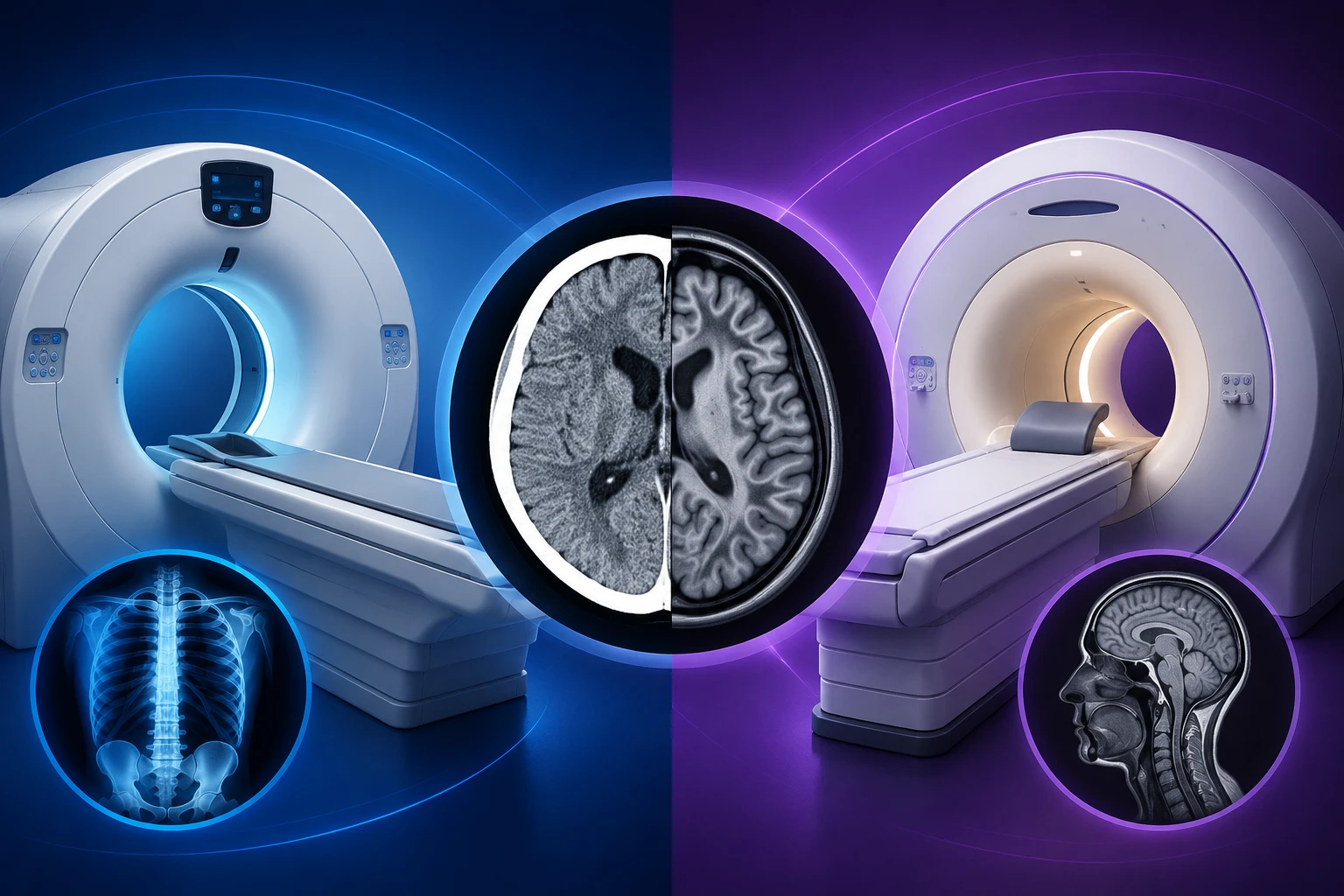
Both CT and MRI create cross-sectional pictures, but they use different physics. Choosing between them depends on the clinical question — bone versus soft tissue, speed versus contrast detail, and whether ionizing radiation is acceptable for that situation.
Computed Tomography (CT)
A CT scanner rotates an X-ray source and detectors around the body, reconstructing thin slices in seconds.
CT excels for trauma, suspected fractures, lung blood clots, and many emergency evaluations where speed matters.
Magnetic Resonance Imaging (MRI)
MRI aligns hydrogen atoms with a strong magnetic field, then reads radio-frequency signals — no X-rays.
MRI is preferred for brain, spinal cord, joints, and many soft-tissue tumors; scans take longer and require screening for implants.
References
RadiologyInfo.org — CT and MRI patient guides (ACR / RSNA).
National Institute of Biomedical Imaging and Bioengineering — imaging basics (NIH).
American College of Radiology — patient resources on imaging safety.
Key Takeaways
- A CT scanner rotates an X-ray source and detectors around the body, reconstructing thin slices in seconds.
- MRI aligns hydrogen atoms with a strong magnetic field, then reads radio-frequency signals — no X-rays.
Frequently Asked Questions
Which has more radiation?
CT uses ionizing radiation; standard MRI does not use X-rays.
Can I have both?
Sometimes sequential studies answer different questions; your clinician orders what is medically necessary.
Which is better for 3D printing?
CT is common for bone models; soft-tissue projects may use MRI or CT depending on structure — see our medical 3D printing articles.
Related articles
Glossary · Frequently asked questions · All Learning Center articles