Do I Need Imaging for a Headache?
Many headaches do not require a CT or MRI. Specialty guidelines describe situations where neuroimaging may be considered — and when routine imaging is often not helpful.
Routine CT or MRI is often not needed for stable headaches that meet migraine criteria with a normal neurologic exam. Imaging may be considered when headache features raise concern — for example sudden maximal “thunderclap” onset, new neurologic deficits, or other clinical red-flag contexts described in imaging appropriateness guidance. Only a clinician who knows your history can decide whether imaging is appropriate for you.
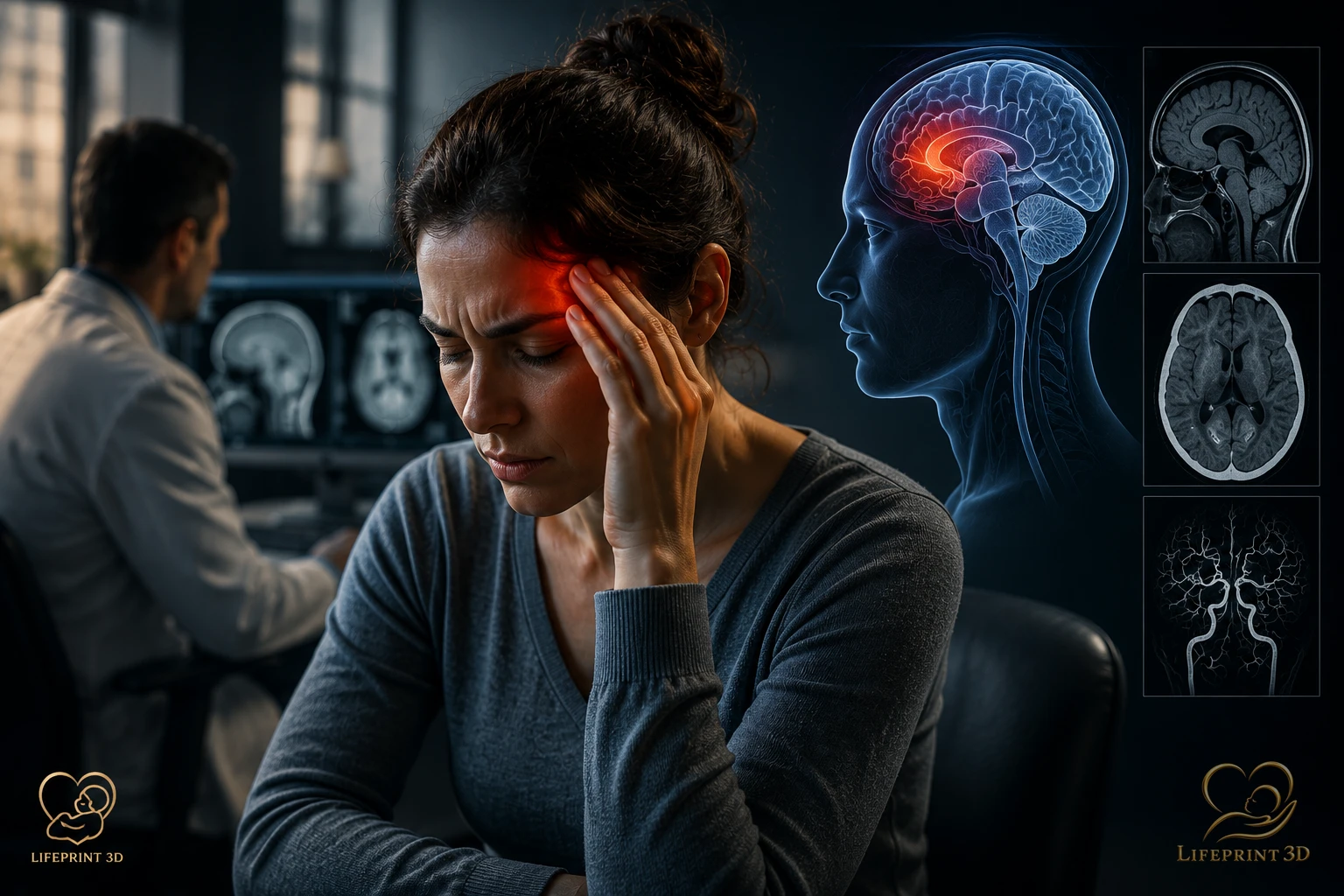
Headache is extremely common, and most episodes are not caused by a dangerous problem that imaging would change. This article explains, in plain language, how professional imaging guidelines and headache societies discuss when neuroimaging may be considered — and why clinicians often do not order a scan for a stable, typical headache pattern. It is general education about imaging, not a diagnosis of your headache and not advice about medications or other treatments.
What This Article Does and Does Not Cover
This page focuses on imaging of headache: when CT or MRI may enter the conversation, and when societies have cautioned against routine neuroimaging. It does not tell you what condition you have, which medicine to take, or whether you personally need a scan.
Emergency symptoms — such as the worst sudden headache of your life, new weakness, trouble speaking, seizure, fever with stiff neck, or head trauma with concerning findings — require urgent clinical evaluation. This article cannot triage an emergency.
Why Many Headaches Are Evaluated Without Imaging
The American College of Radiology (ACR) Appropriateness Criteria for headache note that many headaches are benign and idiopathic and resolve spontaneously or with minor measures, and that imaging is not required for many headache types. The same document explains that imaging decisions are framed around clinical scenarios and “red flag” contexts rather than the mere presence of head pain.
As part of the Choosing Wisely effort, the American Headache Society (AHS) recommended against neuroimaging in patients with stable headaches that meet criteria for migraine. AHS also advised against using CT for headache when MRI is available, except in emergency settings — reflecting that CT and MRI answer different questions and carry different trade-offs.
An AHS systematic review and evidence-based guideline on neuroimaging for migraine concluded that neuroimaging is not necessary in patients whose headaches are consistent with migraine and who have a normal neurologic examination (strong recommendation). That does not mean imaging is never used; it means routine scanning is not the default for typical migraine presentations.
Situations Where Imaging May Be Considered
ACR Appropriateness Criteria discuss initial imaging strategies across headache variants — including sudden severe onset reaching maximum intensity within about an hour, headaches with optic disc edema, migraine or tension-type patterns, trigeminal autonomic features, and chronic headaches with or without progressive change. In sudden severe (“thunderclap”) presentations, noncontrast head CT is commonly discussed as an initial imaging option in appropriateness tables because clinicians are evaluating for time-sensitive intracranial problems.
ACR materials also describe “red flag” contexts in which CT, MRI, or noninvasive vascular imaging may be considered — examples in the guideline abstract include head trauma, cancer, immunocompromised state, pregnancy, age 50 years or older, activity- or position-related headache, or a corresponding neurologic deficit. These are educational categories clinicians use; they are not a self-checklist that replaces a medical evaluation.
AHS guidance on migraine notes that neuroimaging may be considered in selected atypical or changing presentations (for example unusual aura, progressive change in pattern, first or worst migraine, or other atypical features). Many of those considerations are consensus-based with limited direct trial evidence, which is why language on this page stays cautious.
CT Versus MRI in Headache Imaging Education
When imaging is pursued for non-emergent headache questions, MRI is often preferred in specialty discussions because it provides soft-tissue detail without ionizing radiation. CT is faster and more widely available in emergencies and is particularly useful when hemorrhage or certain acute problems are the clinical concern. AHS Choosing Wisely language specifically discouraged CT for headache when MRI is available, except in emergency settings.
For a general comparison of how CT and MRI work, see our Learning Center article on CT scan vs MRI. That comparison is about modality physics and typical strengths — not a personalized order for your headache.
What Imaging Can Show — and What It Cannot
Brain CT or MRI can depict structural findings such as hemorrhage, mass effect, many tumors, some vascular abnormalities (depending on the protocol), and other intracranial changes. A normal study does not prove that pain is imagined, and an incidental finding does not automatically explain symptoms. Imaging answers a clinical question; it does not replace the history and neurologic examination.
Incidental findings can lead to more testing. That is one reason appropriateness guidance emphasizes matching the test to the clinical scenario rather than scanning “just in case” for every headache.
References
American College of Radiology — ACR Appropriateness Criteria® Headache (PMID 31685104; https://pubmed.ncbi.nlm.nih.gov/31685104/).
Loder E, et al. — Choosing wisely in headache medicine: the American Headache Society's list of five things physicians and patients should question. Headache. 2013 (PMID 24266337; doi: 10.1111/head.12233).
Evans RW, et al. — Neuroimaging for Migraine: The American Headache Society Systematic Review and Evidence-Based Guideline. Headache. 2020 (PMID 31891197; doi: 10.1111/head.13720).
ACR Appropriateness Criteria narrative materials on headache variants (https://acsearch.acr.org/).
Key Takeaways
- This page focuses on imaging of headache: when CT or MRI may enter the conversation, and when societies have cautioned against routine neuroimaging.
- The American College of Radiology (ACR) Appropriateness Criteria for headache note that many headaches are benign and idiopathic and resolve spontaneously or with minor measures, and that imaging is not required for many headache types.
- ACR Appropriateness Criteria discuss initial imaging strategies across headache variants — including sudden severe onset reaching maximum intensity within about an hour, headaches with optic disc edema, migraine or tension-type patterns, trigeminal autonomic features, and chronic headaches with or without progressive change.
- When imaging is pursued for non-emergent headache questions, MRI is often preferred in specialty discussions because it provides soft-tissue detail without ionizing radiation.
- Brain CT or MRI can depict structural findings such as hemorrhage, mass effect, many tumors, some vascular abnormalities (depending on the protocol), and other intracranial changes.
Frequently Asked Questions
If my migraine is typical, do I still need an MRI?
Specialty guidance generally says neuroimaging is not necessary for headaches consistent with migraine when the neurologic exam is normal. Your clinician still decides based on your full history — this page cannot clear or order a scan for you.
Is a sudden “worst headache of my life” different?
Sudden severe headaches that peak quickly are treated as a distinct clinical scenario in imaging appropriateness discussions and often prompt urgent evaluation. Seek emergency care for sudden severe or neurologic symptoms; do not rely on this article.
Why might a clinician prefer MRI over CT for headache?
When imaging is appropriate outside emergency hemorrhage pathways, MRI is often discussed because it provides detailed soft-tissue information without X-ray radiation. CT remains important in many acute settings.
Does a normal CT or MRI mean nothing is wrong?
No. Imaging looks for structural findings related to the clinical question. Many headache disorders are diagnosed clinically.
Related articles
Glossary · Frequently asked questions · All Learning Center articles