Why Is an MRI So Loud?
MRI scanners produce loud tapping and knocking during imaging because rapidly switching currents in the gradient coils vibrate in a strong magnetic field. Patient safety pages explain ear protection — the noise itself is expected.
MRI acoustic noise comes mainly from the gradient system: rapidly changing currents in gradient coils, inside a strong static magnetic field, produce Lorentz forces that make the coils vibrate against their mountings — heard as loud tapping, knocking, or chirping. RadiologyInfo states the MRI system may make loud noises and that technologists provide earplugs to help prevent hearing problems associated with scanner noise. Hearing protection is a standard part of safe scanning.
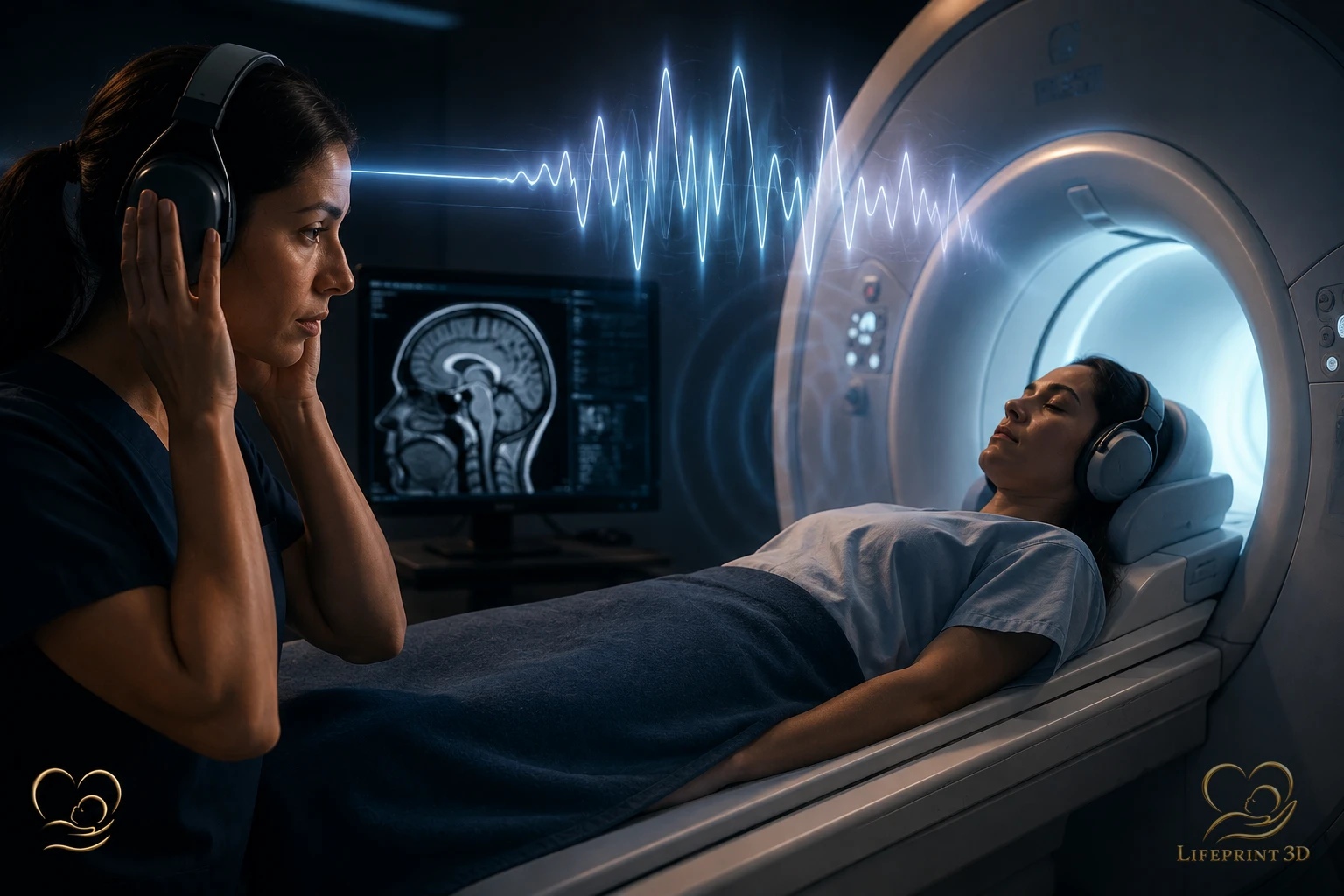
People often remember an MRI less for the pictures and more for the jackhammer-like soundtrack. The noise is expected physics, not a machine malfunction. This article explains why scanners are loud, what patient-facing safety materials say about hearing protection, and how peer-reviewed reviews describe the source of the sound. It is not advice about whether you personally should have an MRI.
The Sound Is Part of How MRI Makes Images
MRI uses a strong static magnetic field, radiofrequency energy, and gradient magnetic fields that change quickly to encode location information in the image. Those gradient switches are what patients hear.
RadiologyInfo’s MRI preparation materials note that when the machine is creating pictures you will hear loud clicking, tapping, and thumping noises, and that you will know images are being acquired because of those sounds.
Gradient Coils and Lorentz Forces
A peer-reviewed review by McJury and Shellock explains that the gradient magnetic field is the primary source of acoustic noise in MRI. Rapid alterations of currents within the gradient coils, in the presence of the strong static field, produce significant Lorentz forces on the coils. Noise — loud tapping, knocking, or chirping — occurs when those forces cause motion or vibration of the coils against their mountings.
A later narrative review by McJury similarly identifies the gradient system as the main acoustic noise source and notes that waveform characteristics produce the variety of audible sounds familiar to patients and MRI staff. Noise levels vary with sequence type and scanner design.
Hearing Protection Is Expected
RadiologyInfo’s MRI Safety page states that the MRI system may make loud tapping, knocking, or other noises during the procedure, and that the technologist will provide earplugs to help prevent hearing loss and other problems associated with scanner noise. It also notes you can communicate with the technologist by intercom or other means.
Use the protection exactly as instructed. If earplugs or headphones feel inadequate, tell the technologist before or between sequences rather than removing protection on your own.
Loud Does Not Mean Dangerous Magnet Failure
The soundtrack can be startling, especially on faster sequences, but loud gradient noise is a known, studied feature of clinical MRI — not a sign that the magnet is “breaking.” Separate safety screening for implants and metal objects remains essential; that is a different topic from acoustic noise.
For general MRI literacy, see understanding MRI scans and CT scan vs MRI. Those articles explain what MRI is used for; this page focuses on why it sounds the way it does.
The Loud Scan Is Often the Volume Used for 3D Work
The gradient noise you hear is part of acquiring the multi-slice or volumetric MRI dataset. When that study was ordered for clinical care, the same DICOM volume is the kind of data that can later be segmented for digital 3D viewing or — in selected educational or planning contexts — a physical printed anatomical model.
Loudness does not mean you should request MRI to obtain a print. A model made from an existing MRI is an educational or communication object, not a replacement for the radiologist’s interpretation, and services that print from imaging you already have should stay downstream of clinical imaging decisions.
References
RadiologyInfo.org (ACR/RSNA) — MRI Safety (https://www.radiologyinfo.org/en/info/safety-mr).
RadiologyInfo.org — How to Prepare for MRI Exam (https://www.radiologyinfo.org/en/info/how-to-prepare-for-mri-exam).
McJury M, Shellock FG. — Auditory noise associated with MR procedures: a review. J Magn Reson Imaging. 2000 (PMID 10931563).
McJury MJ. — Acoustic Noise and Magnetic Resonance Imaging: A Narrative/Descriptive Review. J Magn Reson Imaging. 2022 (PMID 33629790; doi: 10.1002/jmri.27525).
Shellock FG, et al. — Measurement of acoustic noise during MR imaging: evaluation of six “worst-case” pulse sequences. Radiology. 1994 (PMID 8134603).
Key Takeaways
- MRI uses a strong static magnetic field, radiofrequency energy, and gradient magnetic fields that change quickly to encode location information in the image.
- A peer-reviewed review by McJury and Shellock explains that the gradient magnetic field is the primary source of acoustic noise in MRI.
- RadiologyInfo’s MRI Safety page states that the MRI system may make loud tapping, knocking, or other noises during the procedure, and that the technologist will provide earplugs to help prevent hearing loss and other problems associated with scanner noise.
- The soundtrack can be startling, especially on faster sequences, but loud gradient noise is a known, studied feature of clinical MRI — not a sign that the magnet is “breaking.
- The gradient noise you hear is part of acquiring the multi-slice or volumetric MRI dataset.
Frequently Asked Questions
Is it normal for an MRI to sound like a jackhammer?
Yes. Loud tapping and knocking from gradient coils are expected during many sequences. Hearing protection should be provided.
Can MRI noise damage hearing?
That is why earplugs or headphones are standard. RadiologyInfo links scanner noise to potential hearing problems if unprotected. Follow staff instructions.
Do quieter MRI machines exist?
Manufacturers and researchers have developed quieter sequences and hardware approaches, but many clinical exams remain loud. Ask your imaging center what to expect.
Related articles
Glossary · Frequently asked questions · All Learning Center articles